
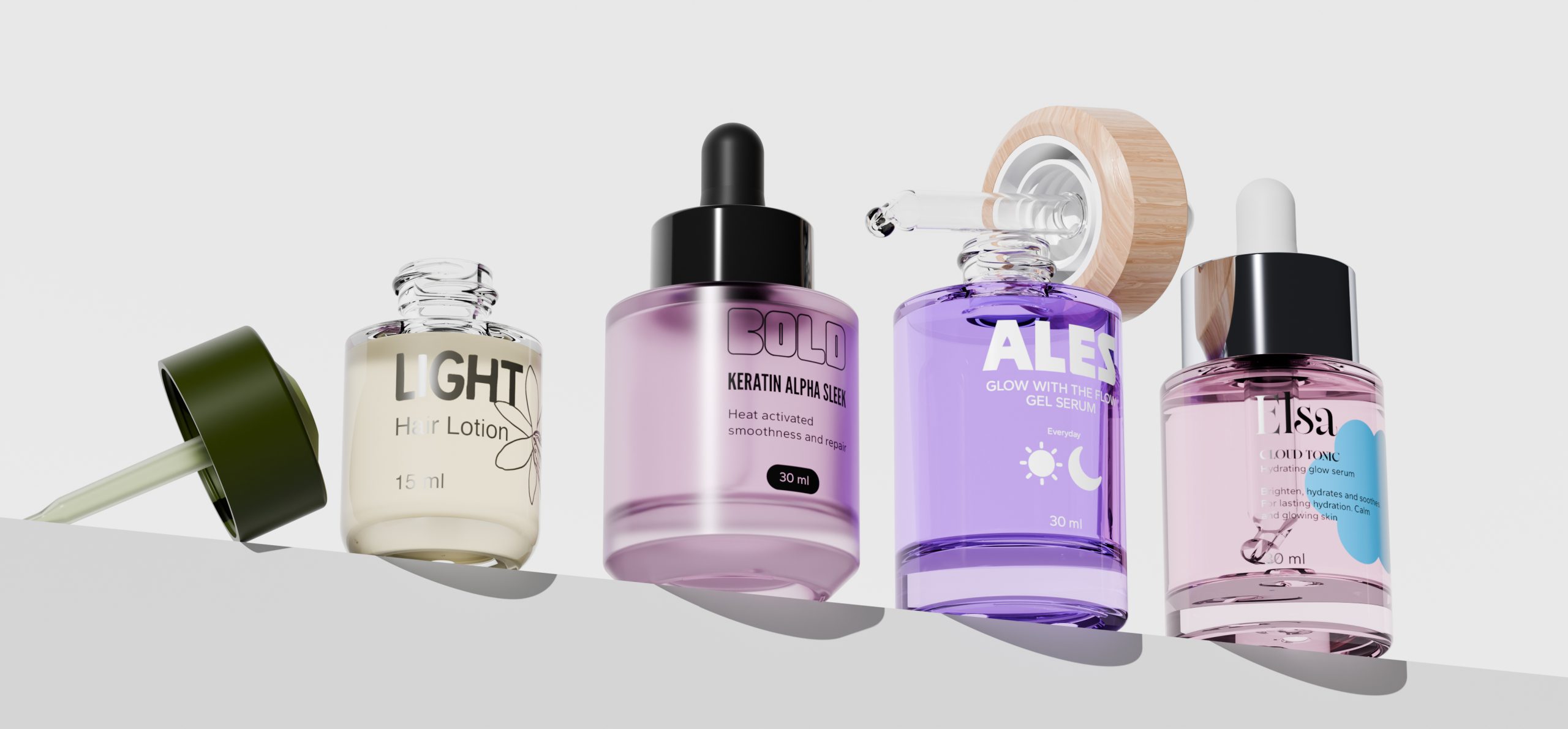
In recent years, skincare shelves have filled with concentrated serums, face oils, boosters and targeted treatments: active-rich formulas sold in 15 or 30 ml formats at a price consumers assess almost drop by drop. For anyone developing a line of this kind, the cosmetic dropper determines much more than the look of the bottle, because it affects the dispensed dose, the contact between the formula and the materials, and the feeling of using a precise product.
And yet, the dropper is often the last component to be chosen, when the bottle and formula have already been fixed and every incompatibility costs weeks. It is better to bring this choice forward, and the questions to ask are few and specific.
Why the dropper should be chosen together with the formula
A dropper is a small system made up of three parts that work together. The bulb, or the push-button in vertically actuated models, creates the vacuum that draws up the product. The collar screws onto the bottle and ensures closure, while the pipette draws up the formula and releases it. Each part either touches the formula or affects how it behaves, so the choice should start in the laboratory rather than from the moodboard.
Three variables guide the decision. Viscosity determines how much product the pipette draws up and how it releases it, and a water-based serum requires different solutions from a dense oil. Composition, from pH and essential oils to solvents and active ingredients, affects how the bulb behaves over time. Finally, the intended user gesture points toward a bulb, a push-button or automatic filling.
If this information arrives late, stability tests may reveal an irregular drop or a bulb that deforms, and weeks may be needed to repeat sampling.
Bottle neck finish and formula compatibility
The bottle neck finish is the first practical constraint. Cosmetic droppers work with standards such as 13/415, 18/400 SP, 18/415 and 24/410, where the first number indicates the diameter in millimetres and the second the thread profile. Choosing the neck finish immediately narrows the range of compatible models.
Each standard has a typical field of use. The 13/415 is intended for small formats, while the 18/400 SP keeps the dropper neck low and compact on cylindrical bottles with a understated profile. The 18/415 is the neck finish with the widest range of models and is used for serums and oils in 15 and 30 ml formats, while the 24/410 is designed for larger bottles.
Alongside diameter, pipette length also matters and is checked for every bottle-and-dropper combination. A pipette that is too short leaves product at the bottom; one that is too long touches the glass and affects the drop. With high-value formulas, residual product becomes a commercial issue because consumers perceive it as waste.
When it comes to chemical compatibility, generic answers should be treated with caution. The resistance of a material depends on the specific formula and must be confirmed through compatibility tests on the finished product, the same tests on which the cosmetic product’s shelf life is based.
Pipette, bulb and materials
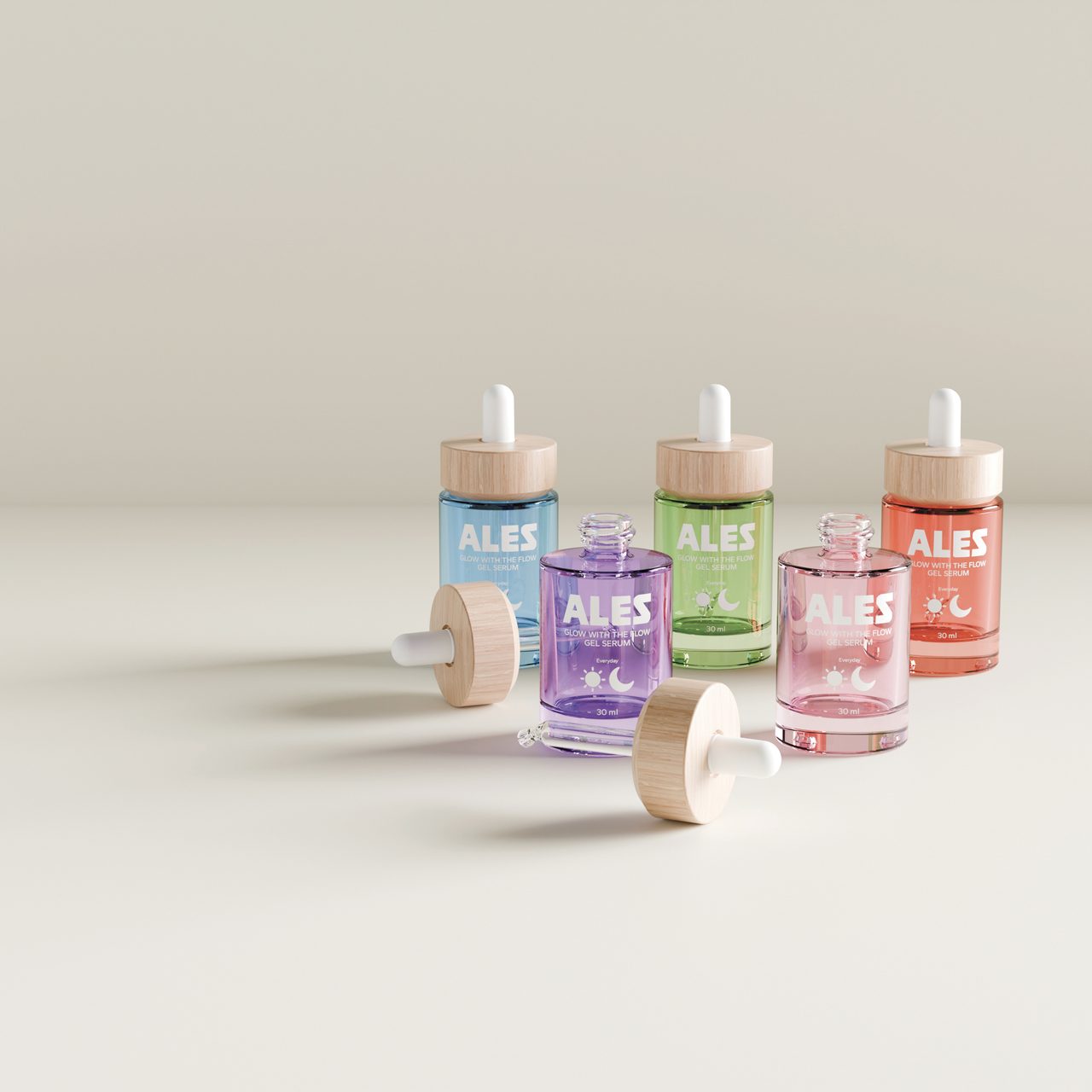
For the pipette, glass remains the classic choice, appreciated for its transparency and inertness. To keep it cleaner at each use, a wiper can be added to remove excess product when the pipette is withdrawn from the bottle. Alternatively, PETG pipettes are available, including opaque or semi-transparent versions, as well as translucent PP pipettes with a pencil-shaped tip for more targeted application. These solutions can also be coloured for a closer match to the brand identity.
The bulb, on the other hand, is the component most strongly affected by the formula, and it is also the one available in the widest range of materials. Nitrile rubber, chlorinated nitrile, natural rubber, silicone, PVC, TPE and PP offer different levels of elasticity, chemical resistance and aesthetic performance. Transparent PVC lets the user see the product rise inside, while nitrile is often indicated for oily formulas, but confirmation must always come from tests on the actual formula.
The material also affects end-of-life handling. Droppers made entirely of polypropylene, with collar, bulb and pipette in the same polymer, are designed with a mono-material approach to simplify separation and recycling. The PPWR makes this increasingly relevant, as explained in the guide to cosmetic refill packaging and the PPWR.
Even a standard dropper leaves plenty of room to make a product recognisable. The collar, which is the most visible surface, is available in glossy or embossed finishes, silver and gold metallisation, aluminium or beechwood overshells, or entirely in wood. Bulbs and push-buttons can be ordered in custom colours and matched to the collar.
On the bottle itself, the most common decoration techniques come into play, from screen printing to metallisation, as described in the guide to custom packaging. Screen printing is an automated process, and the small variations that may occur from one piece to another are due to the technical constraints of the process.
Each customisation option comes with its own threshold, and a special colour for the collar or bulb raises the minimum order quantities compared with standard finishes.
MOQ and continuity of supply
The minimum order quantity for a dropper is assessed on the complete item. The collar and bulb, or push-button, have independent thresholds, and when a non-standard component is introduced, the MOQ for the complete assembly aligns with that of the most restrictive part. This is especially important for brands launching a first line or testing a new serum in limited quantities, the same scenario addressed in the guide to packaging for indie cosmetic brands.
In the early stages, it is advisable to start with combinations of standard components and reserve special colours and finishes for reorders, once volumes have been confirmed.
Continuity remains essential. A dropper chosen for a flagship serum must remain identical even at the fifth reorder, because changing it once the line is on the market means repeating compatibility tests and updating photography and sales materials. Which components are stable in the catalogue is a question worth asking from the very first contact.
What we at Eurovetrocap recommend
For over 40 years, we have worked in primary glass and plastic packaging for cosmetics, make-up, perfumery and pharmaceuticals, with a catalogue of more than 2,500 customisable standard items. Our droppers cover all the neck finishes mentioned above, from the Chicca 13/415 for small formats to the Minerbio 24/410 for larger sizes, including 18/400 SP and 18/415 models such as Parigi, Makeup, New Laura and Tokyo.
For combinations of standard components, the minimum order quantity starts from 1,000 pieces, and when a project requires a non-standard colour or finish, we say so from the outset, together with the resulting MOQ. We check pipette length for every combination with the selected bottle.
As for the supply chain, more than 85% of the catalogue is of European origin and around 15% of Asian origin, as a deliberate selection by market segment and function, with the same quality control throughout the supply chain. For projects aimed at reducing environmental impact, the Zero In•Pack line brings together solutions made with recycled materials, while the Custom department, active since 2024, supports TAILORED and FULL-CUSTOM projects.
To find the dropper best suited to your formula, you can explore the skincare range or contact our team through the contact page, indicating the bottle, formula type and expected volumes. We will reply with the compatible combinations and the relevant minimum order quantities.


