
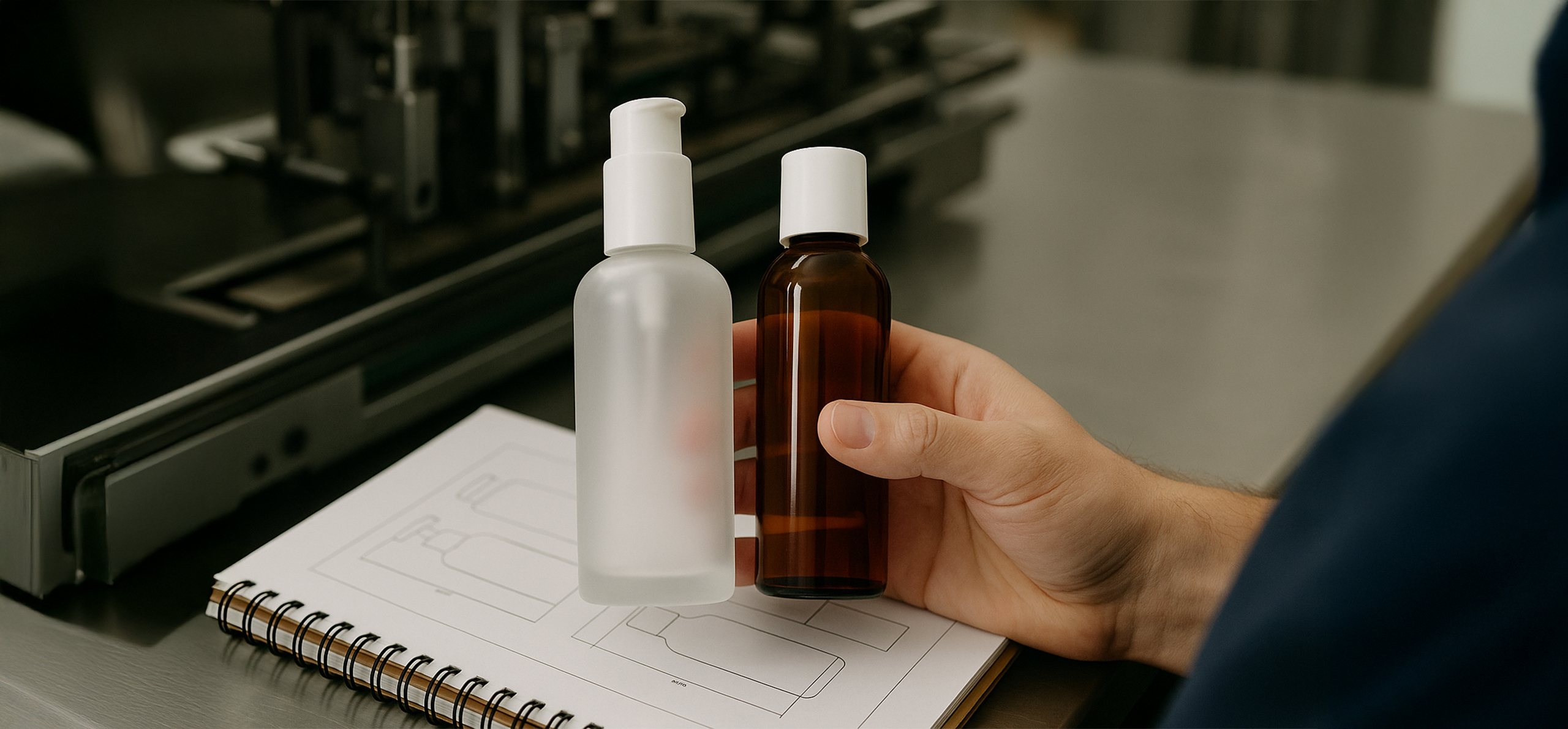
Between the 3D rendering of a bottle and the shelf of the point of sale, there is a crucial, often overlooked phase: the industrialization of packaging. It is here that an effective concept is transformed into thousands of identical pieces, ready to protect the product, seduce the consumer and respect the time and budget constraints set by marketing. When this step is not managed scientifically, the result can be a delayed launch, out-of-control costs, quality non-conformities or – even worse – a pack that is incompatible with the formula.
In this article, we will take a closer look at the most common mistakes that occur during industrialization, explaining how to prevent them through targeted testing, accurate technical drawings, and integrated project management. Whether you’re developing a cosmetic line or updating an existing pack, these guidelines will help you deliver a flawless product the first time.
Industrialization of packaging: what is it really?
Industrialization means transforming a packaging idea into a stable, repeatable and scalable production process, without distorting the aesthetics or functionality imagined in the design phase. In cosmetics, this imposes four essential objectives:
- aesthetic fidelity to the original concept.
- technical compatibility with formula and filling line.
- optimization of time and costs along the entire supply chain.
- consistent quality between batches, from the first prototype to the annual print run.
If the project involves glass containers, custom pumps, multilayer decorations or several international suppliers, the risk of deviating from these objectives increases. Let’s see why, and how to avoid it.
The most frequent errors in the industrialization phase
- Neglecting formula–pack compatibility testing
An “instagrammable” pack is not enough: the bottle must resist surfactants, solvents, essential oils and pH variations. Without compatibility testing, migration, discoloration, deformation or loss occurs. The solution is to adopt an accelerated storage test protocol (at 40 °C, 60 °C and freeze-thaw cycles) on an adequate number of pre-series pieces, monitoring the weight, appearance and performance of the closure for at least 6 weeks. - Underestimating dimensional tolerances
In production, a millimeter can make the difference between a cap that seals and one that “dances.” Designers must provide 2D/3D drawings with realistic tolerances, validated by mold makers and fillers. Before confirming a mold, it is good practice to request resin samples or pilot cavity tests to verify threads, supports, and labeling dimensions. - Select decorations that are difficult to replicate in series
A chrome lacquer with degradé shades can look spectacular on ten prototype pieces, but disastrous on 100,000 units if the process is not stable. During the graphic definition phase, it is necessary to evaluate the industrial repeatability of the decoration technique (screen printing, digital printing, hot stamping) as a function of volumes, lead times and acceptable reject rate. Sometimes it is better to choose an effect that is slightly less extreme but more uniform and quicker to produce. - Ignore Fill Line Compatibility
Not all automatic lines can handle conical shoulders or special micro-collars; some pumps require precise tightening torques that the existing system does not offer. Before freezing the design, a fit test is required in filling to verify: bottle feeding, label positioning, closure cupping, cycle speed and back-pressure resistance. - Coordinating too many suppliers disjointedly
When container, closure, decoration and secondary packaging arrive from four different suppliers, the chances of delay or mismatch increase exponentially. Centralized management – ideally via a single partner with an overview – reduces touchpoints, optimizes the logistics flow and ensures quality consistency. - Underestimating real lead times
Each phase – from the creation of the moulds to colour validation, from screen printing to pump testing – has an incompressible technical time. Planning a buffer-free “go-live”, hoping that everything goes smoothly, is the recipe for postponing the launch. A realistic Gantt chart, shared with all suppliers, includes margins for recovery and clearly defines approval milestones.
Practical checklist for industrialization without surprises
- Tested formula-pack compatibility with accelerated protocols.
- Complete technical drawings shared and stamped by all suppliers.
- Decorations that can be industrialized according to the expected volumes.
- Fit test on the filling line with pre-series samples.
- Wholesaler lead time + stamping + assembly planned in Gantt.
- Centralized project management with a single quality contact person.
If all the boxes are ticked, the transition from prototype to first batch becomes smooth and predictable.
In the industrialization process, tests, tolerances, decorations, logistics and production times must fit together perfectly.
Industrialization also means focusing on sustainability
The scaling phase is the ideal time to optimize weight, materials and processes from an ESG perspective. Reducing the thickness of glass, introducing PCR plastic, eliminating non-recyclable inserts or adopting refill solutions are interventions that weigh little on engineering but a lot on the carbon footprint. Doing so when volumes have not yet exploded allows you to ensure industrial feasibility and quality consistency before investing in large batches.
Why choose Eurovetrocap as an industrialization partner
The industrialization of packaging is not a simple “handover” between designer and factory, but a highly complex process, where tests, tolerances, decorations, logistics and production times must fit together perfectly. Ignoring any of these aspects is equivalent to exposing yourself to unexpected costs, launch delays or – worse – product recalls.
By relying on a partner like Eurovetrocap, you can count on technical expertise, proven solution libraries and integrated management that reduces risk and accelerates time-to-market. So your next packaging will not only look good in rendering, but perfect to the touch, safe for the formula and ready to shine on the shelf from the first batch.


