
When it comes to packaging price lists in the cosmetics sector, the most common risk is to consider it simply as a cost to be contained. In reality, packaging plays a much broader role: it is a strategic element that influences product perception, consumer choice and, consequently, the price list of cosmetic products.
Below, we analyse how much packaging really affects the retail price list, with practical examples and useful tips for finding the right balance between image, quality and profit margins.
Packaging: industrial cost or marketing lever?
Defining an effective cosmetics price list means first and foremost having a clear understanding that packaging, in addition to being the product container, is a vehicle for identity. From an economic point of view, it can represent between 5% and 15% of the industrial cost, with higher peaks for small to medium-sized productions or customised solutions.
But the importance of packaging lies in its impact on perceived value. A screen-printed glass bottle conveys quality and refinement, a plastic jar with a label suggests practicality and simplicity, a perfume bottle decorated with metallic details conveys luxury and craftsmanship. This effect is directly reflected in the consumer’s willingness to pay a higher price.
How much does packaging affect the final price?
There is no single formula: the percentage that packaging represents in the final price varies significantly depending on several key parameters. Among these, production volume has a significant impact: high print runs allow fixed costs to be amortised, while small batches tend to increase the impact of packaging on the unit cost. The materials used, such as glass, plastic or aluminium, influence both the price and the perception of the product. Decoration techniques and customised finishes, such as screen printing, engraving or metallisation, increase the aesthetic value but also the overall cost. Finally, the distribution channel also plays a decisive role: packaging for e-commerce, for example, must guarantee strength and safety, while packaging for retail must prioritise visual impact and distinctiveness on the shelf.
Most common packaging configurations
Below is a rough estimate based on common configurations:
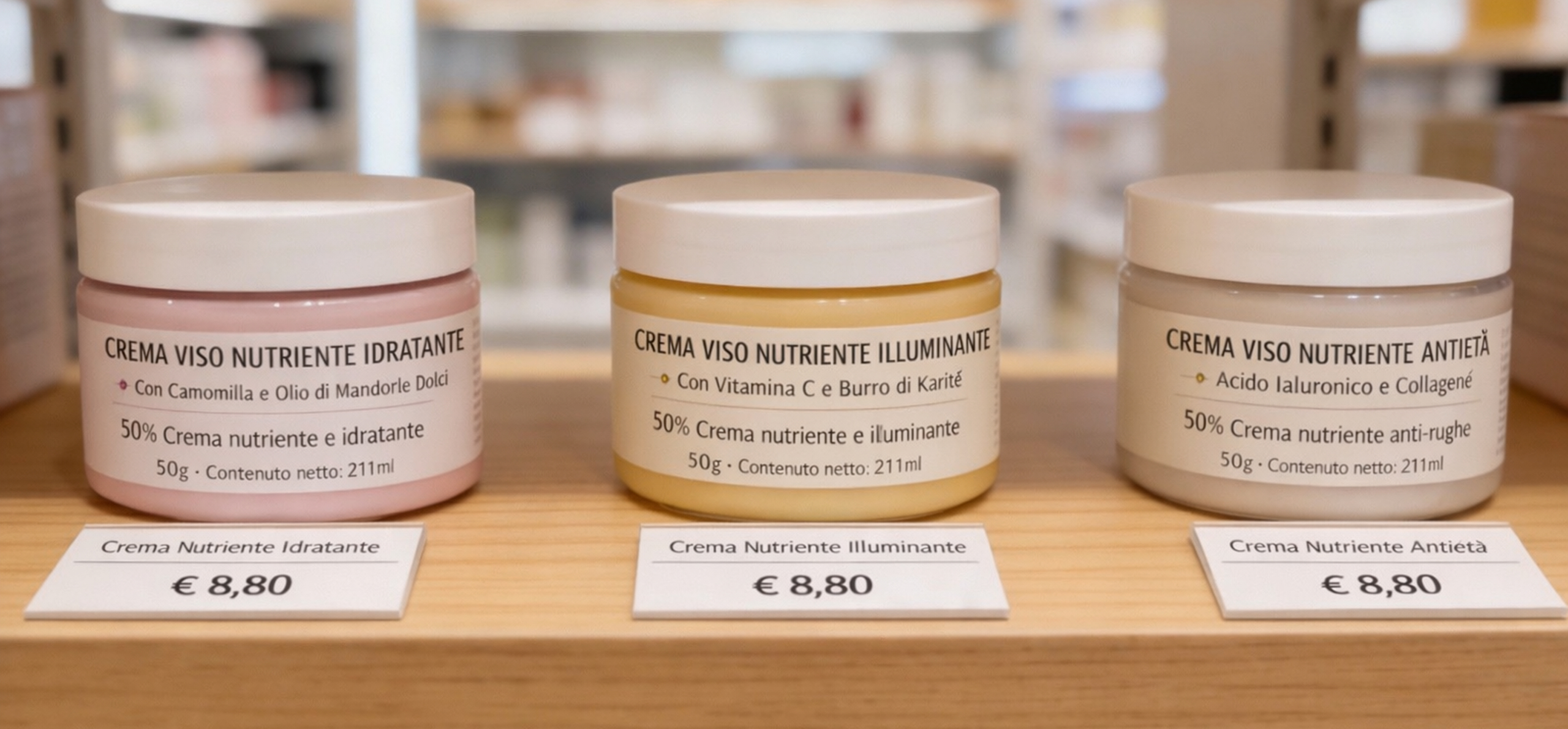
- plastic jar with label: 5-7% of the retail price;
- glass bottle with screen printing: 8-10%;
- decorated glass perfume bottle: 10-15%.
In particular, in initial production runs or in the case of small batches, the cost of packaging can exceed these values. However, with careful design, it is possible to maintain an optimal balance between aesthetic quality, economic sustainability and perceived result.
Creating a cosmetics price list
Anyone who wants to create a truly competitive and consistent cosmetics price list must start with some fundamental questions that guide the entire product design process. It is not just a matter of assigning a numerical value to each item, but of constructing a coherent narrative between price, packaging, target audience and distribution channel. Every design and material choice has a direct impact on brand perception and must be justified by the promise that the product wants to convey to the market. Here are some questions to assess whether the packaging has been designed correctly:
- Does my packaging reflect the brand’s positioning? A minimalist design communicates technicality and reliability, while a stylised and elegant design suggests a premium or niche world.
- Is the selling price justified by the visual and tactile experience of the product? If the customer perceives consistency between price and appearance, the propensity to purchase increases.
- Is the packaging suitable for the intended distribution channel? Perfumeries, e-commerce and pharmacies require different solutions in terms of visibility, ergonomics and impact.
A consistent price list must therefore harmonise cost, quality and target audience, taking into account public expectations and category benchmarks.
Price is a strategic marketing lever
Strategies for optimising packaging and margins
To prevent packaging from eroding product margins without compromising the brand image, it is useful to adopt certain optimisation strategies:
- use standard packaging with distinctive elements: choose bottles already in the catalogue, customised with decorations, engravings or screen printing;
- take advantage of existing moulds: this reduces initial investment costs and speeds up production times;
- consider custom packaging only for sustainable volumes: uniqueness only makes sense if it translates into real competitive advantages;
- manage everything with a single supplier: this allows for greater stylistic consistency and reduces logistical complexities.
These practices allow you to increase perceived value without compromising margins, building a strong and recognisable positioning.
The role of packaging in the sales channel
Each sales channel has different dynamics, expectations and modes of use, and packaging must respond precisely to these variables. It is not enough to have a beautiful design: the container must speak the right language in the right context.
In perfumery, for example, especially when the product is a niche fragrance, visual impact and refined finishes are key elements in ensuring that the identity captures the attention of a demanding audience. In the pharmaceutical sector, on the other hand, functionality and clarity of information prevail, as packaging must inspire confidence and convey safety. In the e-commerce world of make-up and skincare, packaging must be durable, photogenic and guarantee a memorable unboxing experience. Finally, in physical points of sale such as boutiques, packaging also takes on an experiential role: it must be consistent with the store’s aesthetics and help reinforce the brand’s identity.
A well-designed packaging, consistent with the positioning and channel, helps to justify the price, build customer loyalty and increase the average value of the receipt.
Packaging as a strategic investment
Ultimately, well-designed packaging is a real strategic lever for generating value throughout the supply chain. In addition to accounting for approximately 5% to 7% of the final price of the product, it is a key tool for building brand positioning, communicating with the target audience and strengthening corporate identity.
With over thirty years of experience in the cosmetic packaging sector, at Eurovetrocap we are able to offer targeted advice to identify the most suitable solutions for each individual project. We can be your sole point of contact, accompanying your brand from the creation of the packaging to the definition of the price list, ensuring consistency and competitiveness at every stage of the process, from the choice of materials and closures to the most effective decoration techniques.
Tell us your idea: together we can design tailor-made solutions that combine functionality, aesthetics and sustainability, thanks to an extensive catalogue of customisable containers, closures and finishes.


